Backfire G3 Electric Skateboard For Sale
Backfire G3 Electric Skateboards, if you’re hunting for an electric skateboard that feels like a solid compromise between price, speed, and everyday usability, the Backfire G3 is the kind of board that shows up on every sensible rider’s short list. It never aimed to be the flashiest or most extreme model — instead, the G3 tries to hit a practical “goldilocks” zone: fast enough to be fun, stable enough to be safe, and affordable enough to actually buy. Below I’ll walk you through what the G3 is, how it rides, who it’s for, and the real-world trade-offs you should expect.
First impressions & design
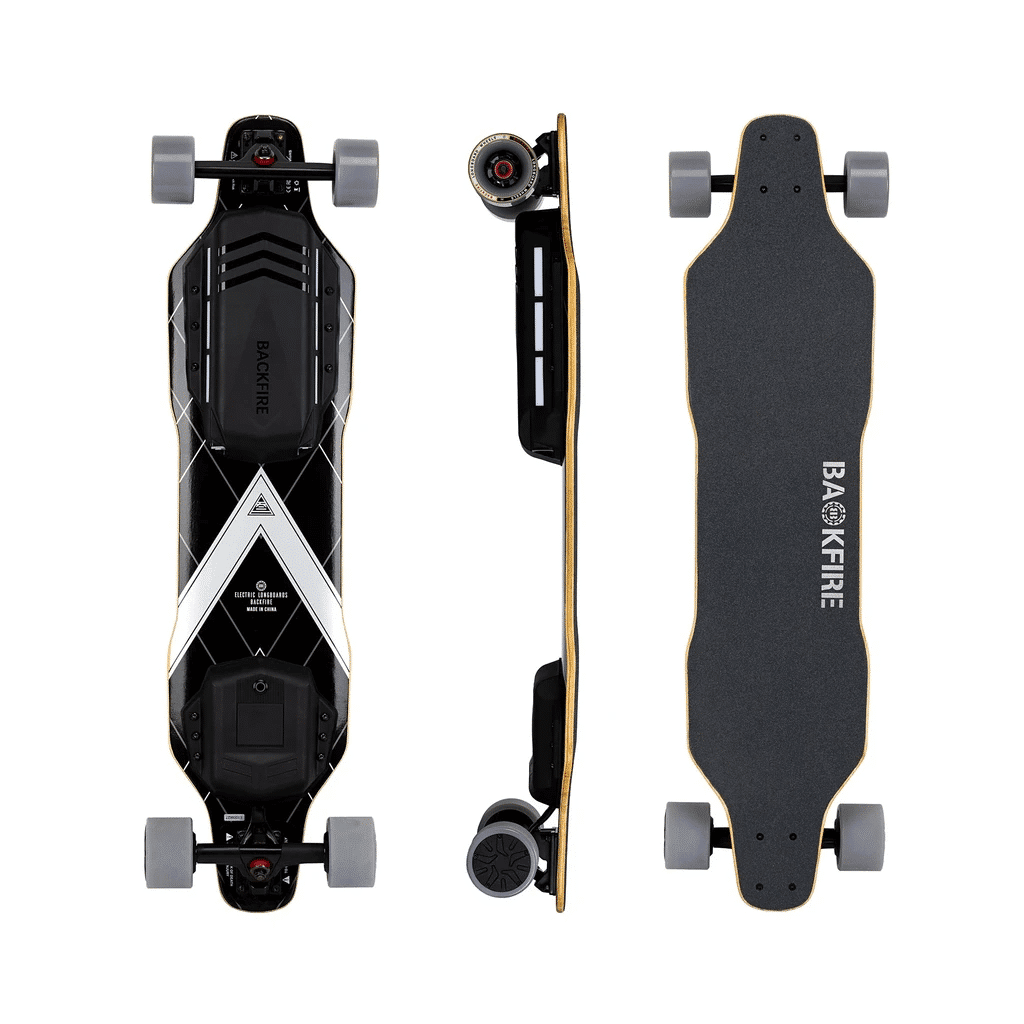
The Backfire G3 Electric Skateboards looks familiar in the best way: a longboard-shaped bamboo/fiberglass deck with subtle ambient LEDs, 96 mm urethane wheels with hub motors, and a relatively slim battery enclosure under the deck. The deck is described by many reviewers as “super flexible” — which gives a forgiving, surfy feel underfoot but sacrifices some of the rigidity riders who push hard might prefer. The G3’s build is clearly aimed at commuters and casual riders rather than adrenaline-seeking downhillers.
Key specs (what actually matters)
-
Top speed: ~46 km/h (about 28–29 mph) under ideal conditions. This is quick enough for fast commuting but still in a manageable range for most riders.
-
Range: Advertised around 24–30 km (15–18.5 miles), though real-world numbers depend heavily on rider weight, speed, and terrain. Expect the lower end of that range if you frequently use higher-performance modes.
-
Battery: Various retailer and review pages list the G3 battery between ~260–311 Wh depending on region/production run — roughly a 50.4 V pack in the neighborhood of 260–311 Wh (Backfire and retailers have slightly different listings across years). That’s plenty for short-to-medium commutes but not an all-day tour.
-
Motors: Dual hub motors, typically listed at 2 × 450 W (peak output and real-world behavior vary). Hub motors keep the board quiet and maintenance-light compared with belt-driven systems.
-
Weight & carrying: The board is relatively light for an electric skateboard (roughly 7.5–8.5 kg / ~17–19 lbs depending on spec and accessories), so carrying it short distances isn’t a terrible chore.
Those numbers put the G3 squarely in the “practical commuter” category: quick enough to get you places fast, but not a specialist speed machine.
How it rides — real-world experience
If you’ve ever ridden a flexible bamboo longboard, you’ll know what to expect: a comfortable, slightly surf-like flex that absorbs small bumps and makes cruising feel mellow. The hub motors give the board a clean, silent acceleration (no belt whine), and the regenerative braking system on the G3 is predictable and helpful for daily stops.
Acceleration is brisk but not brutal — the motors are tuned to give a steady push rather than launch you off the pavement. Top-end acceleration and range depend on which riding mode you use (eco/comfort/sport) and how much you push turbo-style riding. The trucks are typically Caliber-style trucks which favor stability over twitchy carving, again reinforcing the G3’s commuter focus.
Pros — why riders like it
-
Good value: The G3 historically sat in a sweet price bracket compared to premium Backfire models, offering strong everyday performance without the premium cost.
-
Low maintenance: Hub motors mean fewer parts to tune/replace versus belt-driven boards. If you’re not tinkering constantly, that’s a winner.
-
Comfortable deck: The flexible deck makes commuting less jarring and is friendly to riders who prefer a mellow ride.
-
Portable: For an electric skateboard, its weight is reasonable and manageable for short carries.
Cons & trade-offs — what you’ll give up
-
Hub motor limits: Hub motors are tidy, but they’re less torque-rich than belt drives. If you want maximum hill-climbing or heavy-duty acceleration, belt-driven setups outpace hubs.
-
Range-realism: Advertised range often leans optimistic; pushing turbo/sport modes, carrying heavier loads, or climbing hills will reduce distance significantly. Plan on conservative real-world numbers unless you ride gently.
-
Deck flexibility: While comfortable for cruising, the flexible deck can feel imprecise under aggressive pushing or high-speed carving. Riders who prefer a stiff board for carving or technical riding may find it lacking.
Who should buy the Backfire G3 Electric Skateboards?
Buy the G3 if you:
-
Want a dependable, low-maintenance commuter board.
-
Prefer a comfortable, surfy ride over a stiff race deck.
-
Want a relatively affordable entry into the world of electric skateboards with performance that’s useful for daily riding.
Skip the G3 if you:
-
Want maximum hill-climbing or sprint acceleration (look at belt-drive boards).
-
Want a board for aggressive carving, downhill, or heavy payloads (seeker of stiff decks and high torque).
-
Need 40+ km range without recharging.
Practical tips before buying
-
Test ride if possible. Specs don’t capture feel. If you can demo a G3 (shop or friend), prioritize that.
-
Check the build year & spec sheet. Backfire has iterated models over time; battery chemistry and exact Wh can differ between production runs and regions, so confirm the exact spec from the seller.
-
Consider wheel upgrades. The stock 96 mm wheels are fine for smooth surfaces; bumpier routes benefit from larger or softer wheels (and some riders swap to pneumatic options on different decks).
-
Battery care matters. Treat it like any lithium pack: avoid deep full-discharge cycles repeatedly, don’t leave it in extreme heat, and follow the manufacturer’s charging guidelines to extend life.
Maintenance & longevity
The G3’s strength is simplicity. Outside of keeping the battery healthy and periodically checking truck tightness and wheel bearings, there’s not much to do. Hub motors remove belt tensioning and replacement chores, but they mean that if a hub fails you’ll replace or service the whole wheel/motor unit rather than swapping a belt. Keep firmware updated (if Backfire issues updates), and if you hit rough roads often, consider more frequent wheel/bearing checks.
The Backfire G3 is one of those boards that does a lot of useful things well without trying to be the best at any single metric. For riders who want a comfortable, dependable everyday board — a daily commuter that’s easy to live with — it’s a fantastic option and represents solid value. If you want raw performance, max range, or competition-level torque, there are more specialized boards; but for most people who want a fun, practical e-board to get around on, the G3 hits the sweet spot.
If you want, I can also put together:
-
a one-page spec comparison between the G3 and a comparable belt-driven model, or
-
a shopping checklist for test-riding electric skateboards (what to look for, safety checks, and questions to ask the seller).